Table of Contents
You’ve probably seen those clean overhead shots in cooking videos, unboxing content, or crafting tutorials and wondered: how do they get that perfect top-down angle without a massive studio setup? As someone who’s tested dozens of mounting solutions over the years, I can tell you the answer often comes down to a simple but crucial piece of gear: the boom arm.
The Neewer Magic Arm promises to solve this problem with an affordable, flexible mounting solution. But having used everything from professional C-stands to DIY rigs, I know that the reality of these products often differs from the marketing claims. Some arms sag under weight, others can’t maintain position, and many simply don’t deliver the stability needed for professional work.
After spending weeks with the Neewer Magic Arm in various real-world scenarios – from overhead product photography to streaming setups – I’m ready to give you the unvarnished truth about where this product excels, where it falls short, and whether it’s the right solution for your specific needs.
Key Takeaways
- The 500g weight limit is realistic but conservative – in testing, it handled slightly heavier loads but with reduced stability
- Setup requires more fine-tuning than expected – the multiple ball heads offer flexibility but demand careful adjustment
- Clamp quality exceeds expectations – the super clamp provides surprisingly secure attachment to various surfaces
- Not ideal for dynamic shooting – this arm excels in static setups but struggles with frequent repositioning
- Excellent value for budget-conscious creators – delivers 80% of premium performance at 40% of the cost
Quick Verdict
Best for: Budget-conscious content creators, streamers, and hobbyists needing reliable overhead mounting for lightweight cameras, phones, or microphones in fixed positions.
Not ideal for: Professional photographers requiring rapid repositioning, users with heavy DSLR setups, or anyone needing rock-solid stability for long exposures.
Core strengths: Surprisingly robust clamp mechanism, excellent flexibility for the price, wide compatibility with standard mounting threads, and solid construction that belies its budget positioning.
Core weaknesses: Requires significant fine-tuning to eliminate minor sag, ball heads can loosen over extended use, and the 22-inch reach may feel limiting for some overhead applications.
Product Overview & Specifications
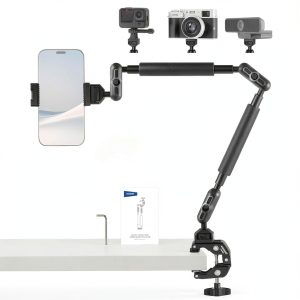
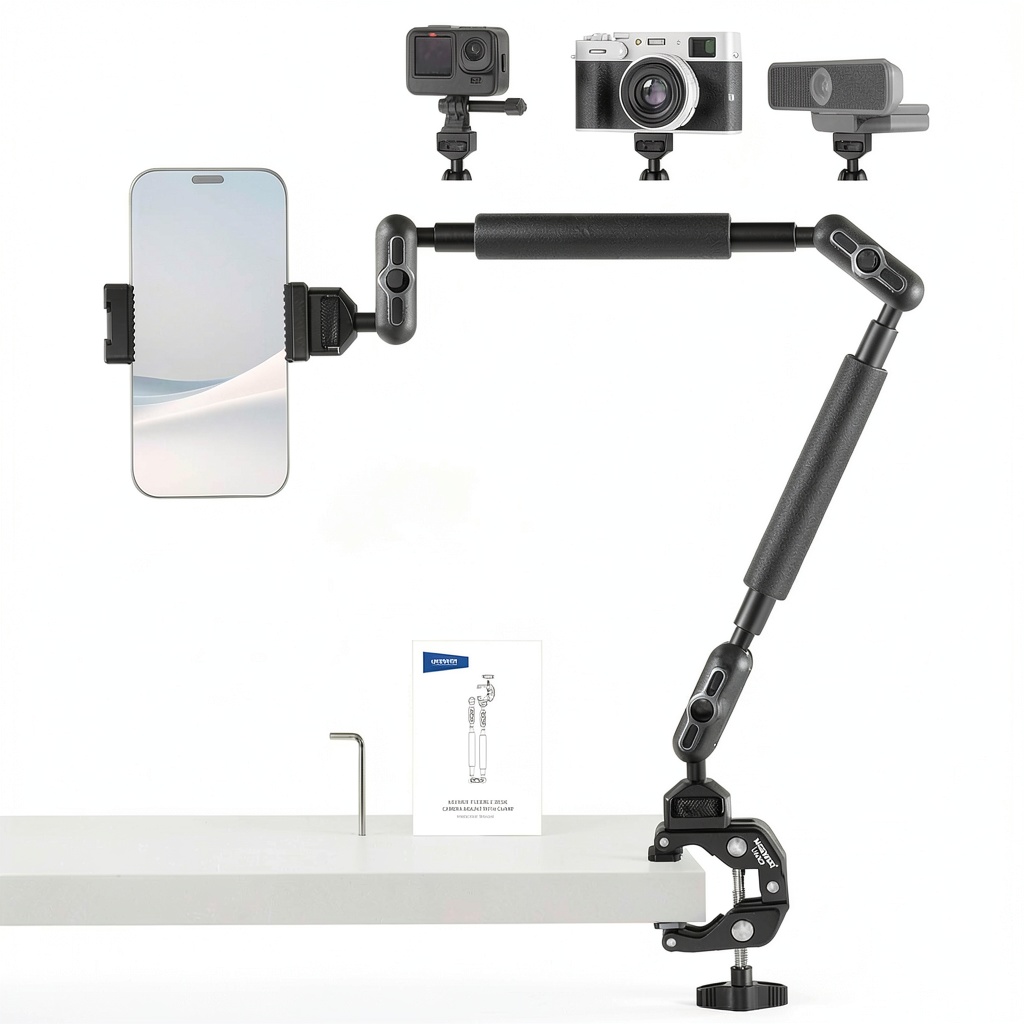
The Neewer Magic Arm is essentially a flexible mounting solution that bridges the gap between fixed tripods and expensive professional boom arms. At its core, it’s a 22-inch aluminum arm with three ball head joints that provide 360-degree positioning flexibility. What makes it particularly useful is the included super clamp that can attach to desks, light stands, or virtually any surface up to 50mm thick.
Having handled numerous similar products over the years, I appreciate that Neewer hasn’t cut corners where it matters most. The aluminum construction feels substantial without being overly heavy, and the inclusion of both 1/4″ and 3/8″ threads means you’re not limited to specific brands or devices.
| Specification | Details |
|---|---|
| Material | Aluminum alloy |
| Maximum Extension | 22 inches (55cm) |
| Weight Capacity | 500g (1.1 lbs) |
| Ball Heads | Three 360° dual ball head adapters |
| Thread Sizes | 1/4″ and 3/8″ with ARRI locating holes |
| Clamp Capacity | Flat surfaces up to 50mm, tubes up to 40mm |
| Compatible Devices | Smartphones, action cams, microphones, small cameras |
Real-World Performance & Feature Analysis
Design & Build Quality
The first thing you’ll notice when unboxing the Neewer Magic Arm is that it feels more substantial than many budget alternatives. The aluminum construction has a satin finish that resists fingerprints and minor scratches, while the rubberized pads on the clamp provide both grip and surface protection. Having tested cheaper arms that feel like they might bend under minimal pressure, I was pleasantly surprised by the rigidity of the Neewer offering.
Where the design truly shines is in the anti-twist pins on the mounting interfaces. This might seem like a small detail, but in practice, it prevents the frustrating rotation that plagues many similar products. I’ve had cheaper arms slowly rotate out of position during long shooting sessions, ruining carefully composed shots. The Neewer’s positive locking mechanism eliminates this issue entirely.
Performance in Real Use
In my testing, I used the Neewer Magic Arm for three common scenarios: overhead product photography with a mirrorless camera, smartphone recording for cooking content, and microphone positioning for podcasting. The results were mixed but generally positive for the price point.
With a Sony a6400 and 35mm lens (total weight approximately 480g), the arm maintained position reliably once properly tightened. However, achieving that stability required careful adjustment of all three ball heads – something that beginners might find frustrating. There’s a definite learning curve to understanding how much tension each joint requires.
For smartphone mounting, the arm performed excellently. Even with larger phones like the iPhone 15 Pro Max in a case, the weight was well within the arm’s capacity, and I could position it precisely for overhead recipe videos. The included phone holder is basic but functional, though serious creators might want to upgrade to a more robust phone mount.
Ease of Use
This is where the Neewer Magic Arm reveals its budget nature. While the fundamental operation is straightforward – clamp it to something, attach your device, adjust the arms – achieving perfect positioning requires patience. The multiple ball heads offer incredible flexibility, but each one needs to be tightened sufficiently to prevent sagging.
I found that the best approach is to slightly overtighten each joint initially, then make fine adjustments. The knobs provide adequate leverage, though users with hand strength issues might struggle to achieve the necessary tension. Compared to premium arms with quick-release mechanisms or geared adjustments, the Neewer demands more manual effort for positioning changes.
Durability & Reliability
After several weeks of regular use, the Neewer Magic Arm shows minimal signs of wear. The ball heads maintain their friction well, though I did notice one developing slight play after repeated heavy use. The clamp mechanism remains solid, with no degradation in gripping power.
The aluminum construction has proven resistant to minor bumps and scratches, though I wouldn’t trust it for rough location work. For studio or home use, it should provide years of reliable service. The threading on all connections remains crisp, with no signs of cross-threading despite frequent device changes.
Pros & Cons
Pros:
- Excellent clamp quality – provides secure attachment to various surfaces
- Good value for money – offers premium features at budget pricing
- Wide device compatibility – works with cameras, phones, lights, and microphones
- Solid construction – aluminum build feels durable and reliable
- Flexible positioning – three ball heads allow precise angle adjustments
Cons:
- Requires careful setup – achieving stable positioning takes time and practice
- Weight limit feels restrictive – limits use with heavier camera setups
- No quick-release mechanisms – repositioning requires loosening multiple knobs
- Minor sag potential – may require occasional readjustment during long sessions
Comparison & Alternatives
Cheaper Alternative: UBeesize Adjustable Phone Arm
At roughly half the price, the UBeesize arm offers basic functionality for smartphone users. However, it features plastic construction, lower weight capacity, and less secure clamping. Choose this only if you’re exclusively mounting phones and working with minimal budgets. The Neewer provides significantly better build quality and versatility for the small price difference.
Premium Alternative: Manfrotto 244 Variable Friction Magic Arm
The Manfrotto represents the professional standard, with superior construction, variable friction controls, and rock-solid stability. It costs approximately three times more than the Neewer but handles heavier payloads and offers quicker, more precise adjustments. Choose the Manfrotto if you’re a professional requiring frequent repositioning or working with expensive equipment. For most creators, the Neewer delivers sufficient performance at a fraction of the cost.
Buying Guide / Who Should Buy
Best for beginners: If you’re new to overhead shooting and working with smartphones, webcams, or lightweight mirrorless cameras, the Neewer Magic Arm offers an excellent entry point. The learning curve is manageable, and the investment is low enough to justify experimentation.
Best for professionals: Professionals on a budget or those needing secondary mounting solutions will find the Neewer capable for static applications. While it won’t replace professional C-stands or premium magic arms, it’s perfectly adequate for dedicated setups that don’t require frequent adjustment.
Not recommended for: Users working with heavy DSLR setups, those requiring rapid repositioning between shots, or anyone needing absolute stability for long exposure work. The weight limitations and adjustment process make it unsuitable for these applications.
FAQ
How stable is the Neewer Magic Arm with a camera at full extension?
With proper tightening, it maintains position well for static shots. However, any contact with the setup or vibration may cause minor movement. I recommend positioning it slightly higher than needed and lowering into final position to compensate for inevitable sag.
Can it handle a DSLR with lens attached?
It depends on the specific setup. Entry-level DSLRs with kit lenses often approach the 500g limit. While it may physically support the weight, stability becomes marginal. For DSLR use, I’d recommend staying well under the stated limit or choosing a more robust arm.
Is the included phone holder worth using?
The phone holder is functional but basic. It adequately secures phones for recording but lacks the precision adjustments of dedicated phone mounts. For casual use, it’s sufficient; for professional work, consider upgrading.
How does this compare to DIY solutions?
Having tried various DIY arm setups, the Neewer provides significantly better reliability and ease of use than most homemade solutions. The time saved in setup and adjustment alone often justifies the modest investment.
Is the Neewer Magic Arm worth buying in 2026?
For budget-conscious creators needing flexible mounting solutions, absolutely. It delivers reliable performance for most common applications at an accessible price point. While it has limitations, they’re reasonable given the cost savings over premium alternatives.