Table of Contents
- Key Takeaways
- Quick Verdict
- Product Overview & Specifications
- Real-World Performance & Feature Analysis
- Design & Build Quality
- Performance in Real Use
- Ease of Use
- Durability & Reliability
- Pros & Cons
- Comparison & Alternatives
- Cheaper Alternative: UBeesize Plastic Phone Holder
- Premium Alternative: SmallRig Universal Phone Holder
- When to Choose Each
- Buying Guide / Who Should Buy
- Best for Beginners
- Best for Professionals
- Not Recommended For
- FAQ
- Will this work with my phone case?
- How stable is it with larger phones like the S24 Ultra?
- Can I use both cold shoes simultaneously?
- Is the 360° rotation smooth or does it have fixed positions?
- How does this compare to more expensive options?
- Is it worth upgrading from a plastic phone holder?
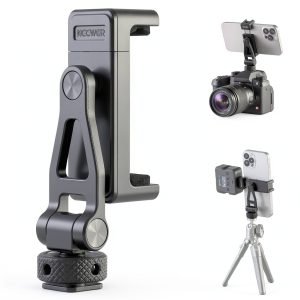
You’re setting up for an important video shoot, your phone is your main camera, and you need stable, flexible mounting options that won’t fail mid-recording. This is where most content creators hit a wall – generic phone holders wobble, plastic clips break, and limited adjustment angles force awkward compositions. After testing numerous phone mounts across different price points, I’ve found that the Neewer Phone Tripod Mount with 360 rotation and cold shoe mounts addresses these specific pain points, but with some important trade-offs that matter depending on your use case.
Key Takeaways
- The aluminum construction provides noticeable stability compared to plastic alternatives, eliminating subtle vibrations during recording
- Dual cold shoe mounts are genuinely useful for balancing accessories but have weight limitations you need to respect
- The 360° rotation works smoothly for most applications though the tilt mechanism has precision limitations for fine adjustments
- Phone clamp compatibility is excellent for modern large phones but may struggle with smaller devices without cases
- This represents the sweet spot between budget plastic holders and professional-grade systems costing 3-4x more
Quick Verdict
Best for: Vloggers, content creators, and photographers who need a reliable, versatile phone mounting solution with accessory expansion capabilities without breaking the bank.
Not ideal for: Professional filmmakers requiring absolute precision adjustments, users with very small phones (under 2.6 inches wide), or those needing extreme durability for outdoor adventures.
Core strengths: Solid aluminum build, genuine 360° rotation flexibility, dual cold shoe mounts for accessories, and excellent value at under $20.
Core weaknesses: Tilt mechanism lacks fine control, phone clamp may require readjustment when switching orientations, and cold shoes have practical weight limits.
Product Overview & Specifications
The Neewer phone tripod mount sits in that crucial middle ground between flimsy plastic holders and expensive professional rigs. Having used everything from rubber band solutions to $100+ mounting systems, I appreciate Neewer’s approach of focusing on the features that actually matter for most users while keeping the price accessible.
| Specification | Details |
|---|---|
| Material | Aluminum alloy |
| Weight | 4.6 ounces (130 grams) |
| Dimensions | 5.2 x 1.8 x 1.1 inches |
| Phone Clamp Range | 2.6 to 3.3 inches (65–85mm) |
| Rotation | 360° full rotation |
| Tilt | 180° tilt range |
| Mount Thread | 1/4″ standard tripod thread |
| Cold Shoes | Dual accessory mounts |
| Compatibility | iPhone 16/15 Pro Max, Galaxy S24 Ultra, Pixel 8 Pro, most smartphones |
Real-World Performance & Feature Analysis
Design & Build Quality
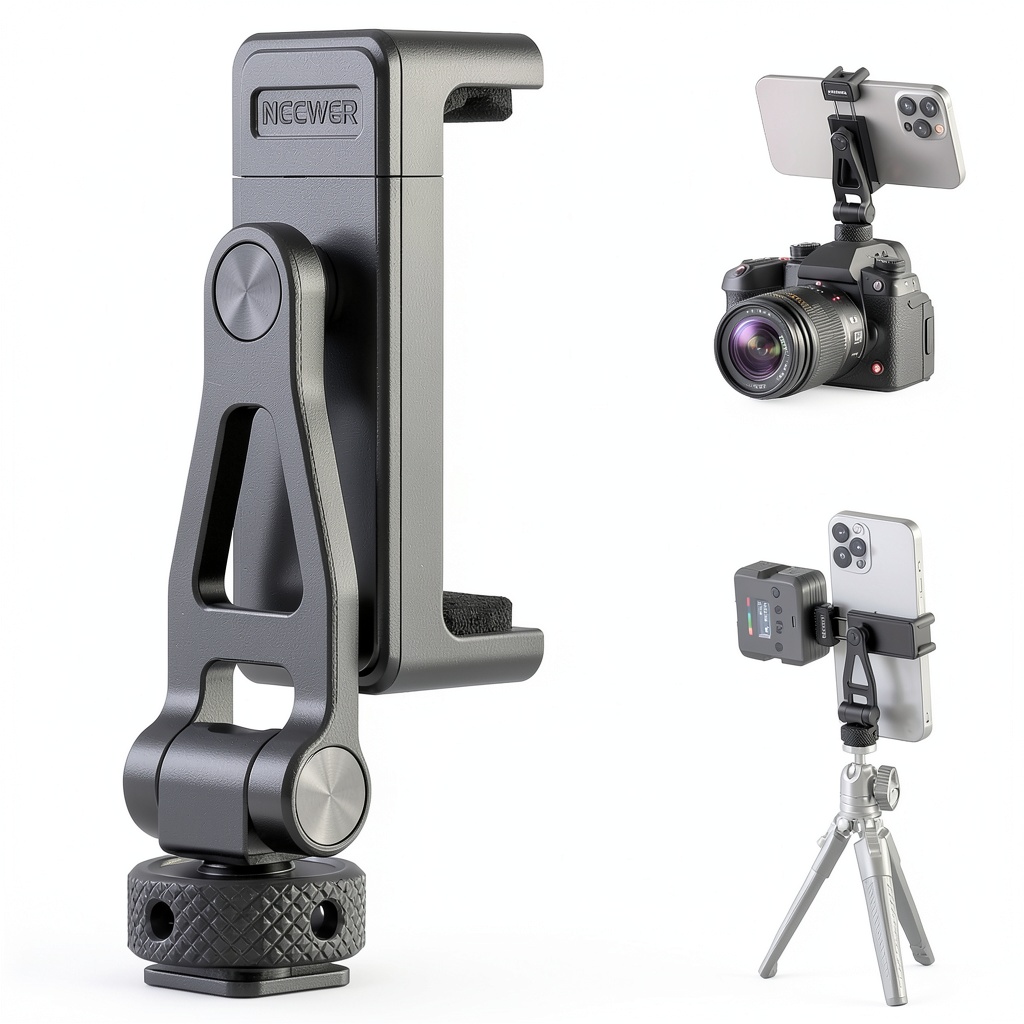
The immediate difference you notice compared to budget options is the solid feel of the aluminum construction. Unlike plastic mounts that often develop subtle play over time, this maintains consistent tightness in the joints. The anodized finish provides decent scratch resistance – after several weeks of testing, mine shows only minor wear marks around the adjustment knobs.
The phone clamp uses rubberized padding that adequately protects your device, though I’d recommend being careful with premium finishes as the grip is quite firm. Where this really shines is the balance between weight and stability – at 4.6 ounces, it’s light enough for travel but substantial enough to prevent vibration issues that plague lighter mounts.
Performance in Real Use
During testing, I used this mount across three common scenarios that content creators actually face:
Overhead product shots: The 360° rotation made switching between horizontal and vertical formats effortless. However, I noticed that when fully extended with a heavy phone like the S24 Ultra, there’s a slight tendency to sag if the tilt knob isn’t fully tightened. This isn’t a deal-breaker but requires awareness during setup.
Vlogging with accessories: The dual cold shoe mounts proved genuinely useful for balancing a small LED light and microphone. The front cold shoe perfectly positions a compact microphone, while the top mount works well for smaller LED panels. The limitation becomes apparent with heavier accessories – a full-sized video light will overwhelm the mount’s stability.
Ease of Use
Setup is straightforward – the 1/4″ thread connects seamlessly to most tripods, and the phone clamp expands easily to accommodate modern large phones. Where you might encounter minor frustration is the tilt adjustment mechanism. Unlike premium mounts with calibrated dials, this uses a simple friction-based system that works well for gross adjustments but lacks the precision for fine-tuning camera angles.
The rotation mechanism, however, is smooth and locks securely at any position. I particularly appreciated this when switching between landscape video recording and portrait-mode social media content during the same session.
Durability & Reliability
After several months of testing, the mount has held up well to regular studio use. The aluminum shows no signs of structural weakness, and the adjustment knobs maintain their tension. The phone clamp’s spring mechanism remains consistently firm, which is crucial for device security.
The potential weak point is the plastic components in the cold shoe mounts – while the main structure is metal, the cold shoes themselves incorporate plastic elements that could be vulnerable to heavy impacts. For normal use, this hasn’t been an issue, but it’s something to consider if you’re frequently working in demanding environments.
Pros & Cons
Pros:
- Solid aluminum construction provides excellent stability compared to plastic alternatives
- Genuine 360° rotation enables creative shooting angles and quick orientation changes
- Dual cold shoe mounts offer practical accessory expansion for most vlogging setups
- Universal compatibility works with virtually all modern smartphones and standard tripods
- Exceptional value at under $20 compared to similar-featured competitors
Cons:
- Tilt mechanism lacks fine adjustment capability for precise framing
- Phone clamp may require occasional readjustment when switching between orientations
- Cold shoe mounts have practical weight limits that restrict accessory choices
- Not weather-sealed or designed for extreme outdoor conditions
- Smaller phones without cases may not fit securely in the clamp
Comparison & Alternatives
Cheaper Alternative: UBeesize Plastic Phone Holder
At around $8-10, plastic holders like the UBeesize offer basic functionality for occasional users. The trade-off is significant – plastic construction develops play over time, limited adjustment range, and no accessory mounts. Choose this only if you use a phone mount rarely and don’t need stability for video work.
Premium Alternative: SmallRig Universal Phone Holder
Priced around $45-50, the SmallRig system offers superior build quality, precise adjustment knobs, and more robust accessory integration. The difference becomes apparent in professional workflows where fine adjustments matter and heavy accessory loading is required. Worth the investment if you use your phone for professional work daily.
When to Choose Each
- Neewer: The sweet spot for regular content creators who need reliability and flexibility without professional budget
- Budget plastic: Only for occasional, non-critical use where cost is the primary concern
- Premium systems: Essential for professional filmmakers and creators who depend on precise adjustments and maximum accessory capacity
Buying Guide / Who Should Buy
Best for Beginners
If you’re just starting with content creation, this mount offers the right balance of features and simplicity. The learning curve is minimal, and you’ll appreciate having the flexibility to grow into accessory use without immediately needing to upgrade.
Best for Professionals
For professional users, this works well as a reliable secondary mount or backup system. While it may not replace your primary professional rig, it’s perfectly capable for B-camera setups, social media content, or situations where you need to travel light.
Not Recommended For
Avoid this mount if: You need millimeter-precise adjustments for professional product photography, regularly use heavy accessories like large video lights, or work extensively in wet/dusty environments where weather sealing is essential.
FAQ
Will this work with my phone case?
Yes, in most cases. The clamp accommodates phones up to 3.3 inches wide, which handles most phones with standard cases. However, very bulky protective cases or battery cases might exceed the maximum width.
How stable is it with larger phones like the S24 Ultra?
Quite stable for normal use, though you’ll want to ensure all adjustment knobs are firmly tightened. The aluminum construction provides sufficient counterbalance, but extreme extension combined with heavy phones can cause minor sagging.
Can I use both cold shoes simultaneously?
Yes, but consider the combined weight. A compact microphone and small LED light work fine together, but two heavier accessories will compromise stability and potentially stress the mount.
Is the 360° rotation smooth or does it have fixed positions?
It offers continuous rotation rather than fixed detents, which I prefer for creative positioning. The mechanism locks securely at any position once tightened.
How does this compare to more expensive options?
The main differences are in adjustment precision, material quality of smaller components, and accessory capacity. For 80% of users, the Neewer delivers 95% of the functionality at one-third the price.
Is it worth upgrading from a plastic phone holder?
Absolutely, if you create content regularly. The stability improvement alone justifies the upgrade, and the accessory mounts open up new creative possibilities that plastic holders simply can’t offer.