Table of Contents
- Key Takeaways
- Quick Verdict
- Product Overview & Specifications
- Real-World Performance & Feature Analysis
- Design & Build Quality: Metal Makes a Difference
- Performance in Real Use: The 360° Promise
- Ease of Use & The Cold Shoe Advantage
- Durability & Reliability
- Pros & Cons
- Comparison & Alternatives
- Buying Guide / Who Should Buy
- Best For Beginners
- Best For Professionals & Advanced Users
- Not Recommended For
- FAQ
You’ve probably hit that frustrating moment when you’re trying to set up the perfect shot and your phone mount feels like it’s working against you. Maybe it’s slipping, can’t hold the angle, or just feels flimsy. As someone who’s tested dozens of these accessories for everything from studio product photography to on-location vlogging, I understand the hunt for that sweet spot between affordability, durability, and functionality. The Neewer Phone Tripod Mount promises to hit that mark with its aluminum construction, 360-degree rotation, and the versatility of dual cold shoes.
But does it deliver in real-world conditions, or is it just another piece of gear that looks better in the product photos? I’ve put this mount through its paces to give you the unvarnished truth, complete with the trade-offs and scenarios where it genuinely shines—or falls short.
Key Takeaways
- Solid Build for the Price: The aluminum alloy construction provides a noticeable step up in rigidity compared to common plastic mounts, reducing wobble during recording.
- Versatility is the Main Draw: The dual cold shoes are a game-changer for creators wanting to add a microphone and a small light without needing extra rigging equipment.
- Precision Has Limits: While the 360° rotation works, the tilt mechanism can be slightly stiff, making fine adjustments for precise angles a two-handed operation.
- Phone Size Matters: The clamp is truly universal but may feel less secure with smaller, lightweight phones compared to heavier max-size models.
- Best for Intermediate Users: It’s an ideal upgrade from a basic mount but professionals needing absolute precision might want a higher-end option.
Quick Verdict
Best for: Content creators, vloggers, and hobbyist photographers who need a sturdy, versatile mount for multi-accessory setups without a professional-grade budget.
Not ideal for: Users who only need a simple, ultra-lightweight holder for occasional use, or professionals requiring buttery-smooth, single-handed adjustments for critical filming.
Core Strengths: The combination of metal build quality, dual cold shoe mounts, and full rotation in a sub-$20 package is where the Neewer mount delivers exceptional value. It transforms a basic tripod into a capable content creation station.
Core Weaknesses: The tilt mechanism lacks the fine-tuning fluidity of more expensive models, and the spring-loaded clamp, while secure, doesn’t inspire the same confidence as a threaded locking system on premium mounts.
Product Overview & Specifications
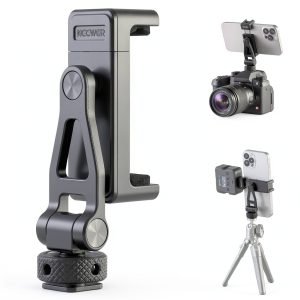
The Neewer Phone Tripod Mount is a compact, metal accessory designed to bridge the gap between your smartphone and a world of photographic equipment. At its heart, it’s a problem-solver for anyone tired of the limitations of flimsy plastic holders. The core promise is stability and expandability.
| Specification | Details |
|---|---|
| Material | Aluminum Alloy |
| Weight | 4.6 oz (130 g) |
| Dimensions | 5.2 x 1.8 x 1.1 in (13.2 x 4.6 x 2.8 cm) |
| Phone Clamp Range | 2.6 to 3.3 in (65–85 mm) |
| Tripod Thread | 1/4″-20 (Standard) |
| Cold Shoes | 2x Standard Size |
| Rotation | 360° Pan & 180° Tilt |
| Compatibility | iPhone 16/15 Pro Max, Galaxy S24 Ultra, Pixel 8 Pro, etc. |
The 1/4″-20 thread is the universal language of tripods, monopods, and camera cages, meaning integration is seamless. The 85mm maximum clamp width confidently accommodates today’s large smartphones, even with thinner cases.
Real-World Performance & Feature Analysis
Design & Build Quality: Metal Makes a Difference
Unboxing the Neewer mount, the first thing you notice is the weight and feel of the aluminum. It’s cold to the touch and has a matte finish that resists fingerprints. This isn’t just about aesthetics; it’s about inertia. A heavier mount is a more stable mount. When you pan or tilt, the mass helps dampen small vibrations and prevents the setup from feeling top-heavy, especially with a larger phone attached.
The joints are machined cleanly, with no visible burrs or sharp edges. Compared to a typical $10 plastic mount, the difference is night and day. The plastic ones often have flex in the body itself, which can introduce a slight shake into your video. The Neewer’s rigidity means the movement comes only from the intended rotation points, which is a significant advantage.
Performance in Real Use: The 360° Promise
I tested the rotation and tilt in two common scenarios: creating a slow pan for a B-roll sequence and switching between portrait and landscape modes for social media content.
Scenario 1: The Overhead Product Shot. For a flat lay or overhead shot, you need a stable setup that won’t droop over time. I mounted the Neewer on a tripod, extended the arm horizontally, and attached an iPhone 15 Pro Max. The lock held firm with no sagging during a 30-minute recording session. The tilt mechanism, while stiff, provided enough resistance to keep the heavy phone perfectly in place. This is where the metal construction pays off.
Scenario 2: On-Location Vlogging. I used the mount on a small travel tripod for a mock vlogging setup, attaching a Rode VideoMic Me-L and a small LED panel to the cold shoes. The ability to have a complete audio-visual package on a single, compact mount is incredibly efficient. The 360° rotation allowed for easy framing, whether I was shooting myself or flipping the phone to capture the scene. However, making a smooth, controlled pan by hand was challenging. The rotation isn’t fluid; it’s functional. For buttery-smooth motion, you’d still need a dedicated video head with a drag control.
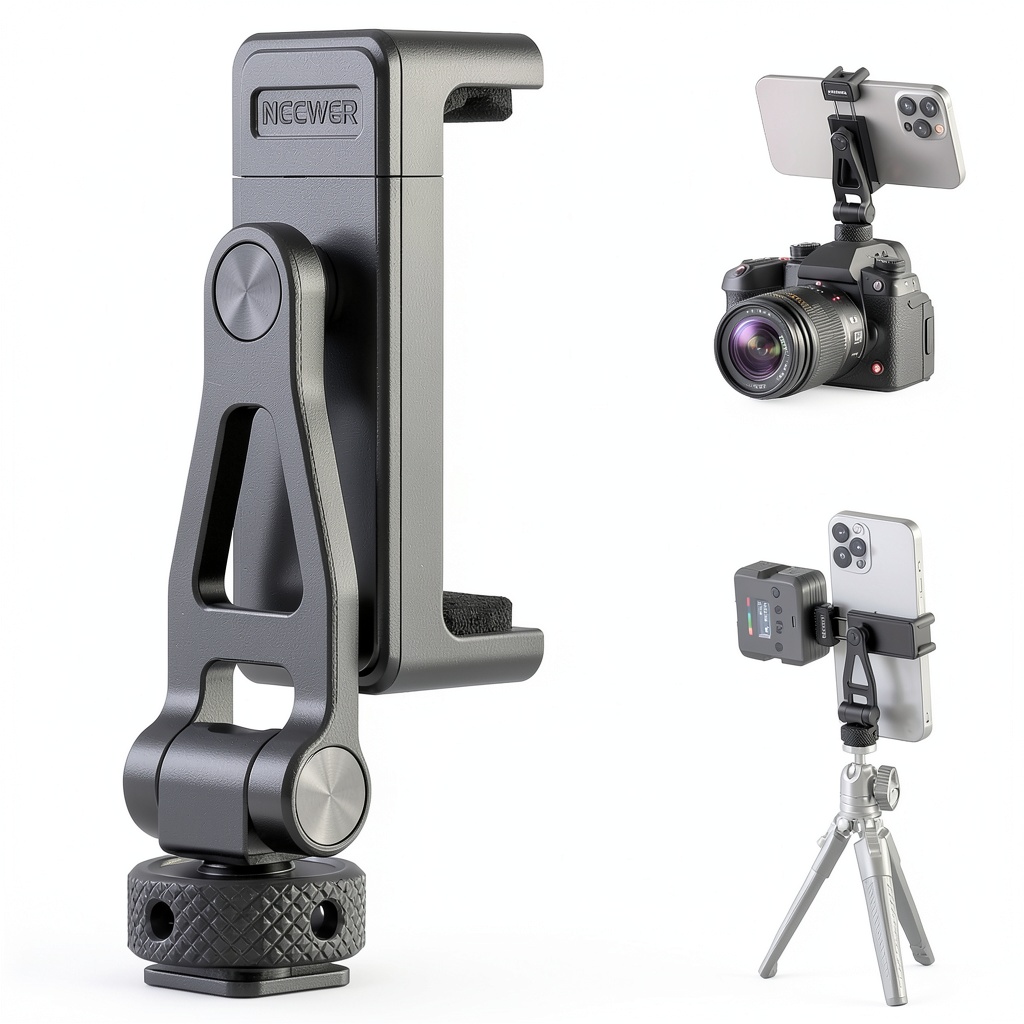
Ease of Use & The Cold Shoe Advantage
The dual cold shoes are arguably the mount’s killer feature. Most budget mounts have one, if any. Having two allows for a mic-and-light combo, which is the standard for professional-looking video. The shoes are standard size, so they fit accessories from brands like Rode, Ulanzi, and SmallRig without issue.
Mounting the phone is straightforward: squeeze the spring-loaded clamp, insert the phone, and release. It’s secure for most situations. However, a word of caution: with smaller, lighter phones, the clamp’s tension can feel overkill and might make you nervous about stressing the phone’s frame. For a large iPhone Pro Max or Galaxy Ultra, it feels perfect. This is a detail you won’t find in the spec sheet.
Durability & Reliability
After several weeks of use, including being tossed in a gear bag (admittedly, not recommended), the Neewer mount shows no signs of wear. The anodized finish has resisted scratches, and all the screws and joints remain tight. The primary point of potential long-term wear is the plastic thread insert where the mount attaches to the tripod. It’s a common cost-saving measure, but I would have preferred a fully metal thread for ultimate peace of mind, especially if you’re frequently attaching and detaching it.
Pros & Cons
Pros:
- Robust Aluminum Build: Eliminates flex and provides a stable base, a significant upgrade from plastic competitors.
- Dual Cold Shoes: Enables a professional mic-and-light setup directly on the mount, a huge value-add.
- Secure Grip: The clamp holds modern large phones firmly with no slippage.
- Excellent Value: Packs features found on mounts that cost twice as much.
- Full Compatibility: Standard 1/4″ thread works with virtually all tripods and accessories.
Cons:
- Stiff Tilt Mechanism: Adjusting the vertical angle requires more force than expected, lacking fine-control fluidity.
- Potential Overkill for Small Phones: The clamp is designed for large devices and may feel less optimal for smaller models.
- Plastic Thread Insert: While functional, a all-metal thread would inspire more confidence for heavy-duty use.
- Not a Fluid Head Replacement: The 360° rotation is for positioning, not for creating silky-smooth panning shots.
Comparison & Alternatives
To understand the Neewer’s place in the market, it’s helpful to compare it to a budget option and a premium alternative.
Cheaper Alternative: Generic Plastic Phone Mount ($5-$10)
- Value Difference: The primary difference is material. Plastic mounts are light and cheap but often suffer from body flex and less secure clamps. They typically have one cold shoe, if any.
- When to Choose: If you need a mount for very occasional, lightweight use and budget is the absolute top priority. You’re sacrificing stability and expandability for a lower price.
Premium Alternative: SmallRig Phone Holder with Cold Shoe (Approx. $35-$40)
- Value Difference: SmallRig is a benchmark for professional build quality. Their mount often features a more refined adjustment mechanism with smoother movement, a superior locking system (sometimes with a safety thread), and arguably more durable finishing. You’re paying for precision and absolute reliability.
- When to Choose: If you’re a professional using your phone for client work, or if you demand the smoothest possible adjustments and the most robust construction money can buy. The Neewer offers 85% of the performance for about half the price.
Buying Guide / Who Should Buy
Best For Beginners
If you’re just starting in content creation and want to move beyond handheld video, the Neewer mount is a fantastic first “serious” accessory. It teaches good habits about stable shooting and allows you to experiment with audio and lighting without a huge investment. The learning curve is minimal.
Best For Professionals & Advanced Users
For pros who use a phone as a B-camera or for quick social media captures, this mount is a reliable and cost-effective tool. It’s perfect for rigging a phone to a cage or using it in a multi-camera setup where the absolute finest movement isn’t critical. It’s a workhorse, not a precision instrument.
Not Recommended For
Avoid this mount if: You only take still photos occasionally and don’t plan to use external accessories. A simpler, lighter holder would suffice. Also, if your primary need is to create smooth, cinematic pans and tilts during recording, you need a dedicated fluid head tripod, not just this mount.
FAQ
Q: Will this mount fit a phone with a thick case?
A: The clamp opens to 85mm, which should accommodate most phones with standard to moderately thick cases. However, for bulky, ruggedized cases, it’s best to remove the phone for a secure fit.
Q: Can I use this with a gimbal?
A> Technically, if your gimbal has a 1/4″-20 thread, yes. But it’s not ideal. The mount adds significant weight and size, which can throw off the gimbal’s balance and motor performance. Gimbals are designed for the phone to be mounted directly.
Q: Is the Neewer mount better than Ulanzi’s similar model?
A> Ulanzi offers comparable mounts in this price range. The differences are often minor—a slightly different finish or clamp design. Both are reputable brands in this segment. The choice may come down to specific design preferences or current pricing.
Q: Is the $18.99 price tag worth it compared to a $10 mount?
A> Absolutely, if you value stability and the option to add accessories. The jump from plastic to metal is the most significant upgrade you can make in phone mounts. The dual cold shoes alone are worth the extra few dollars if you plan to enhance your audio or lighting.